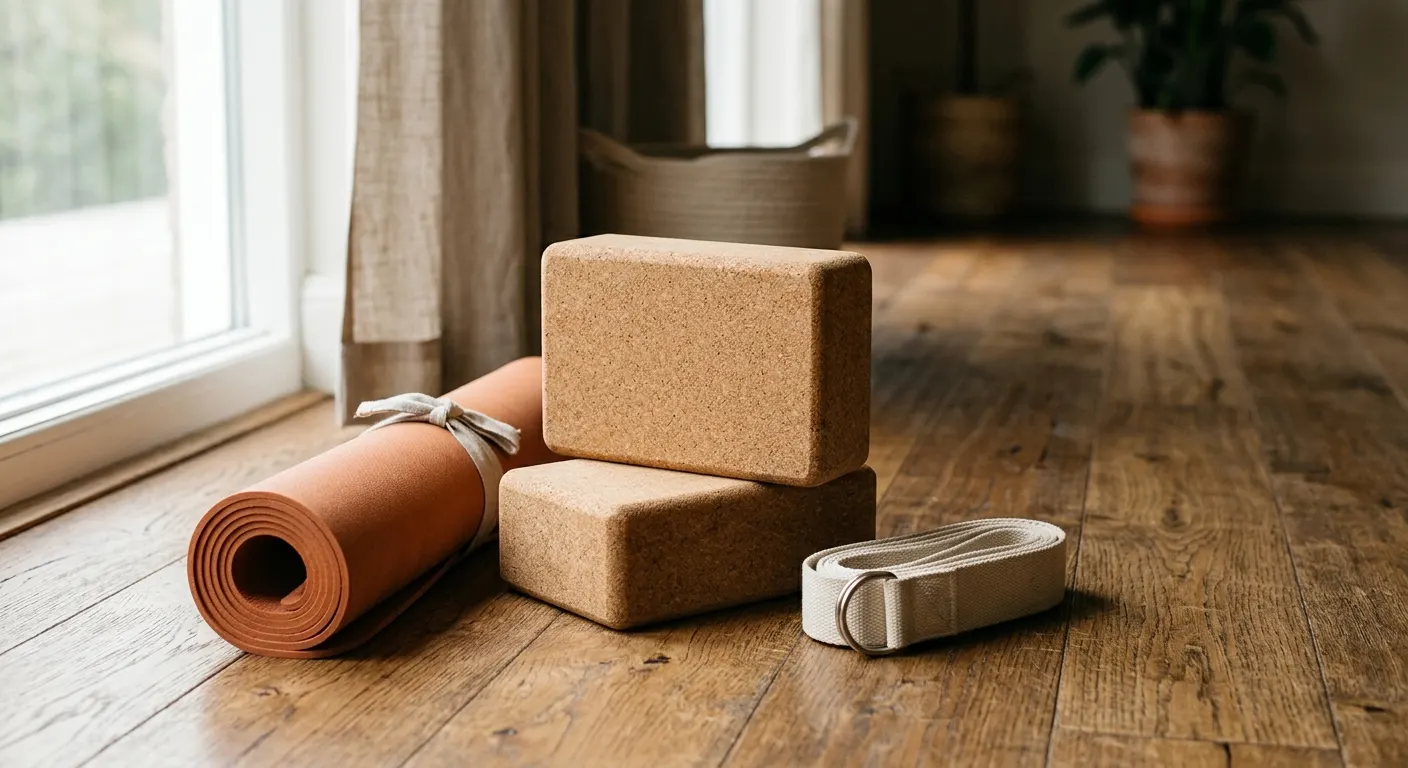
Yoga Props for Beginners: Blocks and Straps
By Mateara . 8 min read . Updated June 2026
Yoga props are not a concession to inflexibility. They are tools that make every pose safer, more anatomically honest, and more effective. A block under your hand in Triangle pose lets you lengthen your spine instead of dumping into your hip. A strap looped around your foot in Seated Forward Fold lets you keep a long spine instead of rounding over folded legs and compressing your lumbar discs. Start with one pair of blocks and a strap and you cover the vast majority of what a home practice needs. The Manduka Cork Yoga Block and the Manduka Align Yoga Strap 8 Foot are where most teachers would send you first.
The short answer
Start with two blocks and one 8-foot strap, and you have covered almost every beginner and intermediate prop need. Cork blocks like the Manduka Cork are firmer and more stable under body weight than foam; foam blocks like the Gaiam 2-Pack are lighter and cost less. For straps, an 8-foot cotton or recycled polyester strap with a metal D-ring buckle handles forward folds, shoulder openers, and leg stretches for most adults.
This guide contains affiliate links. Mateara may earn a commission at no cost to you.
Why teachers always put blocks and a strap in your hands first
New students often feel embarrassed using props because they associate them with inability. Most experienced practitioners use them more than beginners do, not less. A block under the standing hand in Half Moon pose lets an advanced student work on the balancing mechanics rather than fighting for reach. A strap in Extended Hand-to-Big-Toe gives a teacher control over the leg angle and hip alignment even with excellent hamstring flexibility.
The practical reason to own blocks and a strap is that they make poses anatomically correct rather than compensatory. Without a block under the hand in Triangle, a tight practitioner side-bends to the floor and loses the lateral stretch entirely. With the block, the spine stays long and the intended muscles engage. This is why studios stock dozens of each.
Cork versus foam blocks: the honest comparison
Cork is denser, heavier, and more stable under body weight. When you rest your hand on a cork block in a balancing pose, it does not compress or wobble. The Manduka Cork Yoga Block and the Jade Yoga Cork Block both have a surface that grips better when your hands are damp, which makes them the better choice for hot yoga and sweaty flows where you might be leaning full weight on the block.
Foam blocks are lighter and cheaper. The Gaiam Foam Yoga Block Set of 2 gives you two blocks for under $20, which covers the pair most poses require, at a weight that makes carrying them to class easy. The Hugger Mugger Standard Foam Yoga Block uses a slightly denser EVA than generic budget blocks and holds its shape better under repeated use. Foam is the right choice if you are a beginner buying your first set and want to spend less while you decide whether you will practice long-term.
For anyone planning to practice regularly and wanting blocks that last years without compressing, cork is the better long-term investment. The Jade Yoga Cork Yoga Block and Strap Bundle bundles a cork block with an 8-foot strap from the same brand, which is a practical starter kit if you want eco-friendly natural materials in a matched set. Most practitioners end up buying two cork blocks eventually; you cannot do most restorative sequences with just one.

Manduka Cork Yoga Block
A dense, sustainably harvested cork block with a naturally grippy texture that improves when hands are damp. Widely used in studios and by teachers for its stability under body weight and resistance to denting compared to foam alternatives.

Jade Yoga Cork Block
A sustainably sourced cork block from the same brand known for natural-rubber mats. Slightly lighter and less dense than the Manduka cork block, and a good pairing with the Jade Harmony mat for a matching natural-materials practice kit.

Gaiam Foam Yoga Block Set of 2
A pair of standard 4-inch high-density EVA foam blocks that deliver adequate support for most beginner and intermediate yoga poses at one of the lowest price points on the market.

Hugger Mugger Standard Foam Yoga Block
A well-regarded 4-inch foam block from one of yoga's longest-established prop brands, with a slightly denser EVA than most entry-level blocks and good size consistency that holds up under regular studio rotation.
Jade Yoga Cork Yoga Block and Strap Bundle
A bundled set of one cork block and one 8-foot D-ring strap from Jade Yoga, designed to give beginners a matched starting kit at a modest saving over buying both separately.
The three heights of a block and when to use each
Every standard block has three usable positions: lowest (4 inches), medium (6 inches), and tallest (9 inches). Most beginners default to the tallest height because they cannot reach the floor, then discover that the tallest height wobbles if the block is foam and tips if placed on the narrow edge.
The lowest height is stable enough for arm balances and poses where you are putting significant weight through the block. Use the medium height for most standing poses where you need modest lift. The tallest height is primarily useful in restorative poses, seated meditation, and for people with very limited range of motion in forward folds where even medium height does not bring the floor close enough.
In Supported Bridge pose, a block on its lowest or medium height under the sacrum is one of the most effective restorative props in yoga, and the firmness of cork versus foam makes a real difference when you are resting your full pelvis on it for several minutes.
Yoga straps: length, buckle, and material
An 8-foot strap is the right length for the majority of adults. It gives enough length to loop around a foot and hold both ends while keeping a straight spine in Seated Forward Fold, to link hands behind the back in shoulder openers, and to extend a leg in Reclining Hand-to-Big-Toe without pulling the hip. The Manduka Align Yoga Strap 8 Foot is 8 feet of recycled polyester with a metal D-ring buckle that holds under tension without slipping.
If you are taller than about 6 feet 2 inches or specifically work on shoulder mobility and dance-inspired extensions, a 10-foot strap like the Hugger Mugger Cotton Yoga Strap 10 Foot gives useful extra reach. The 10-foot length feels unwieldy in shorter everyday poses but is worth it for shoulder openers where you hold the strap behind your back with arms extended.
The Gaiam Yoga Strap 8 Foot is a budget-friendly 8-foot option with a metal D-ring and soft cotton webbing that is gentler against bare skin than synthetic materials. For someone just starting out who wants the softest feel, it is a practical choice at a low price. The Yoga Accessories 6 Foot D-Ring Cotton Strap at 6 feet is fine for people under 5 foot 6 or for studios equipping shared prop shelves economically.

Manduka Align Yoga Strap 8 Foot
An 8-foot strap made from recycled polyester webbing with a metal D-ring buckle that locks under load. Manduka's most popular strap option with colour-matched loops and a loop at one end that aids in self-adjustment during holds.
Hugger Mugger Cotton Yoga Strap 10 Foot
A 10-foot extra-long cotton strap with a secure D-ring buckle, well regarded for its thicker webbing that resists twisting and cutting into the hands during prolonged holds.
Gaiam Yoga Strap 8 Foot
A soft cotton webbing strap in multiple colour options with a metal D-ring buckle, one of the most popular entry-level straps on Amazon. Gentle against skin, easy to clean, and appropriately sized at 8 feet for most adults.
Yoga Accessories 6 Foot D-Ring Cotton Strap
A no-frills 6-foot cotton strap with a metal D-ring, popular as a low-cost introductory strap or as a second strap for studio lending. Shorter length is fine for most women of average height and for mat-carrying use.
Four poses that show you why these props matter
Seated Forward Fold (Paschimottanasana): loop the strap around the balls of both feet and hold both ends, keeping your elbows slightly bent and your spine long. Pull only enough to maintain that length. Without the strap, tight hamstrings force you to round the lower back, compressing the lumbar discs rather than stretching the posterior chain.
Triangle Pose (Trikonasana): place a cork block on its lowest height beside the front foot, on the inside of the ankle. Rest your lower hand on the block and lengthen the side body rather than reaching for the floor. The block allows a proper lateral extension regardless of hamstring flexibility.
Supported Bridge (Setu Bandha Sarvangasana): slide a block on its medium height under the sacrum at the widest flat part. This transforms an active backbend into a restorative chest and hip-flexor opener. Use cork or the firmest foam available; a soft foam block compresses under body weight in this position.
Shoulder Opener: hold the strap in both hands at slightly wider than shoulder width, arms in front. Inhale and lift the arms overhead and back behind you as far as mobility allows. The strap sets the distance so both arms move together and you cannot cheat by letting one shoulder wing out. This is the safest way to work shoulder range of motion with no risk to the joint.
Featured in this guide
Manduka Cork Yoga Block
A dense, sustainably harvested cork block with a naturally grippy texture that improves when hands are damp. Widely used in studios and by teachers for its stability under body weight and resistance to denting compared to foam alternatives.
Gaiam Foam Yoga Block Set of 2
A pair of standard 4-inch high-density EVA foam blocks that deliver adequate support for most beginner and intermediate yoga poses at one of the lowest price points on the market.
Manduka Align Yoga Strap 8 Foot
An 8-foot strap made from recycled polyester webbing with a metal D-ring buckle that locks under load. Manduka's most popular strap option with colour-matched loops and a loop at one end that aids in self-adjustment during holds.
Jade Yoga Cork Block
A sustainably sourced cork block from the same brand known for natural-rubber mats. Slightly lighter and less dense than the Manduka cork block, and a good pairing with the Jade Harmony mat for a matching natural-materials practice kit.
Hugger Mugger Cotton Yoga Strap 10 Foot
A 10-foot extra-long cotton strap with a secure D-ring buckle, well regarded for its thicker webbing that resists twisting and cutting into the hands during prolonged holds.
Jade Yoga Cork Yoga Block and Strap Bundle
A bundled set of one cork block and one 8-foot D-ring strap from Jade Yoga, designed to give beginners a matched starting kit at a modest saving over buying both separately.
Related roundups
FAQ
Frequently asked questions
How many yoga blocks do I actually need?+
Two. Almost every pose that calls for a block calls for two: one under each hand in Triangle or Half Moon, one under each side of the torso in Supported Savasana side variations, one under the sacrum in Supported Bridge and one reserved in case the teacher calls a different pose. Studios stock them in pairs for good reason. If budget is a constraint, buy two foam blocks now and upgrade to cork when you are sure you will practice regularly.
Is a D-ring buckle or cinch buckle better for a yoga strap?+
Metal D-ring buckles are more secure under sustained tension and the better choice for stretching and physical therapy work where you hold a position for several breaths. Cinch buckles allow faster one-hand adjustments and are convenient for poses where you adjust frequently, but they can slip under very high load. For most home practitioners, a D-ring strap is the right call.
Can I use a block as a meditation seat?+
Yes. A foam block placed on its medium height under the sit bones raises the hips above the knees, which makes cross-legged sitting considerably more comfortable for people with tight hips. A cork block can serve the same purpose but is harder for extended sits. For daily meditation practice of more than ten minutes, a dedicated buckwheat zafu cushion provides better long-term comfort and adjustability.
Should beginners use props or try to do poses without them first?+
Use props from the first class. The point of a prop is not to make a pose easier in a way that diminishes its effect. It is to allow the pose to work correctly in your body as it is right now. A strap that lets you keep a long spine in a forward fold is building the flexibility the pose is meant to develop. Doing the fold without it and rounding the back bypasses the target muscles and risks the lumbar spine.